
As banking and financial services increasingly move online, digital identity verification has become a foundation of modern security. Banks and financial institutions must verify customers quickly and accurately while protecting them from increasingly frauds.
This need for verification also extends to safe deposit lockers, where identity checks help prevent unauthorised access and protect customers’ valuables. This is why many people ask: why do credit checks before opening safe deposit lockers? Such checks may be part of broader customer due diligence and risk assessment requirements. In this article, we will explore what identity verification is, why it matters, how it works, and the key challenges financial institutions face when verifying customers in today’s digital world.
Why Do Credit Checks Before Opening Safe Deposit Lockers?
Before discussing why safe deposit locker credit checks are necessary, it is important to understand what a safe deposit box is. A safe deposit box is a private, secured compartment inside a bank, designed to give customers a protected place to keep valuables and important possessions, from jewellery and certificates to legal documents and personal keepsakes. But are safe deposit boxes safe? Yes, they are generally considered a highly secure option for protecting valuables. Banks or private vaults use strong physical security and controlled entry systems to help keep customers’ belongings protected from unauthorised access.
Banks deal with sensitive financial information and large amounts of money every day, which makes them a major target for fraudsters and financial criminals. A single gap in the verification process can potentially allow stolen identities, money laundering, or other illegal activity into the financial system.
For this reason, banks use several verification methods rather than relying on a single check. These can include government-issued ID verification, biometric authentication, proof of address for safe deposit boxes, financial background checks, customer due diligence, and continuous transaction monitoring.
Meeting the Rules That Govern Banking
One of the biggest reasons banks have strict verification procedures is regulatory compliance. Financial institutions are required to follow frameworks such as Know Your Customer (KYC) and Anti-Money Laundering (AML) regulations.
These requirements help banks establish who their customers are, understand potential risks, and identify suspicious activity. Ignoring these obligations can result in serious financial penalties and reputational damage.
Stopping Fraud Before It Starts
Scammers are always looking for new ways to take advantage of financial networks. Stolen personal information, synthetic identities, fake documents, and increasingly sophisticated digital manipulation can all be used to impersonate legitimate customers.
Effective safe deposit box identity verification gives banks an opportunity to detect these warning signs before an account is opened or access is granted. This protects both the institution and genuine customers from financial losses and fraudulent activity.
Security Is Part of the Customer Experience
Customers want their money and personal information to be protected, but they also expect banking services to be quick and convenient. If security processes are confusing or unnecessarily complicated, customers may abandon applications or look elsewhere.
A well-designed verification process therefore needs to provide both strong protection and a smooth customer experience. When customers know that the bank has reliable safeguards in place, it can also strengthen their confidence in the institution.
Keeping Financial Services Accessible
Security measures must also be designed carefully so they don’t create unnecessary barriers for legitimate customers. Someone who lacks a traditional document or struggles with a complicated digital verification process shouldn’t automatically be treated as suspicious.
Banks therefore need to find the right balance: strong enough to keep fraudsters out, but accessible enough to serve genuine customers.
Why is Customer ID Verification Mandatory in Banks?
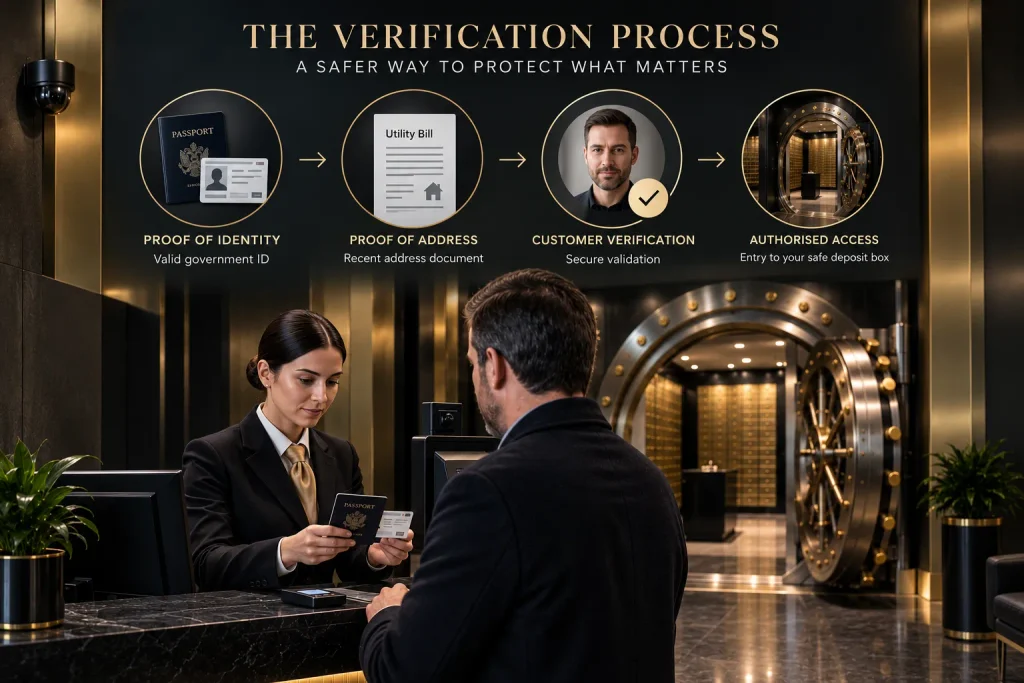
Identity verification is not simply a security measure for banks; it is a regulatory obligation. Financial institutions operate under several laws, standards, and regulatory frameworks designed to prevent money laundering, terrorist financing, fraud, and other financial crimes. These requirements generally cover three key areas: knowing who the customer is, assessing their level of risk, and continuing to monitor their activity after onboarding.
Safe Deposit Box KYC Requirements
KYC requirements require banks or private vaults to establish and verify a customer’s identity before providing certain financial services. Depending on the service, banks or private vaults may collect details such as the customer’s full name, date of birth, residential address, and identification number. The information must generally be verified using reliable and independent sources, such as government-issued identification documents or approved electronic verification methods.
Customer Due Diligence (CDD)
Identity verification is only one part of the process. Through customer due diligence for safe deposit boxes, private vaults or banks assess the potential risks associated with a customer. This may involve understanding the customer’s occupation or business, expected account activity, source of funds, and ownership structure where relevant.
Enhanced Due Diligence (EDD)
Risk levels can vary from one client to another. When a customer, transaction, or relationship is considered higher risk, banks may need to carry out Enhanced Due Diligence (EDD). EDD involves collecting and reviewing additional information to better understand the customer and the potential risks involved. This can include obtaining more details about the source of wealth or funds and applying closer monitoring.
Anti-Money Laundering Checks
KYC and CDD form important parts of a bank’s broader Anti-Money Laundering (AML) framework. AML requirements are designed to help financial institutions identify and prevent the use of banking services for illegal activities. Banks may need to identify suspicious transactions, investigate unusual customer behavior, maintain appropriate records, and report potentially suspicious activity to the relevant authorities.
Ongoing Customer Monitoring
Verification doesn’t necessarily end once an account has been opened. Banks are generally expected to keep customer information up to date and monitor transactions throughout the relationship. If a customer’s activity suddenly changes or begins to show unusual patterns, the bank or private vault may need to investigate further, update the customer’s risk assessment, or submit a report where required by law. At The Post Vault, ongoing customer verification and security procedures help ensure that access to safe deposit facilities remains limited to verified customers.
What Happens When Banks Fail to Comply?
Safe deposit box compliance checks are critical because the consequences of failing to meet KYC and AML obligations can be substantial. Depending on the severity of the breach and the applicable jurisdiction, financial institutions may face large fines, regulatory restrictions, increased supervision, legal consequences, and serious reputational damage.
Ultimately, proof of identity for a safe deposit box exists for more than simply checking someone’s ID. They help banks establish who their customers are, understand the risks they may present, detect suspicious activity, and protect the wider financial system from abuse
Which Security Features Make a Safe Deposit Box Truly Secure?
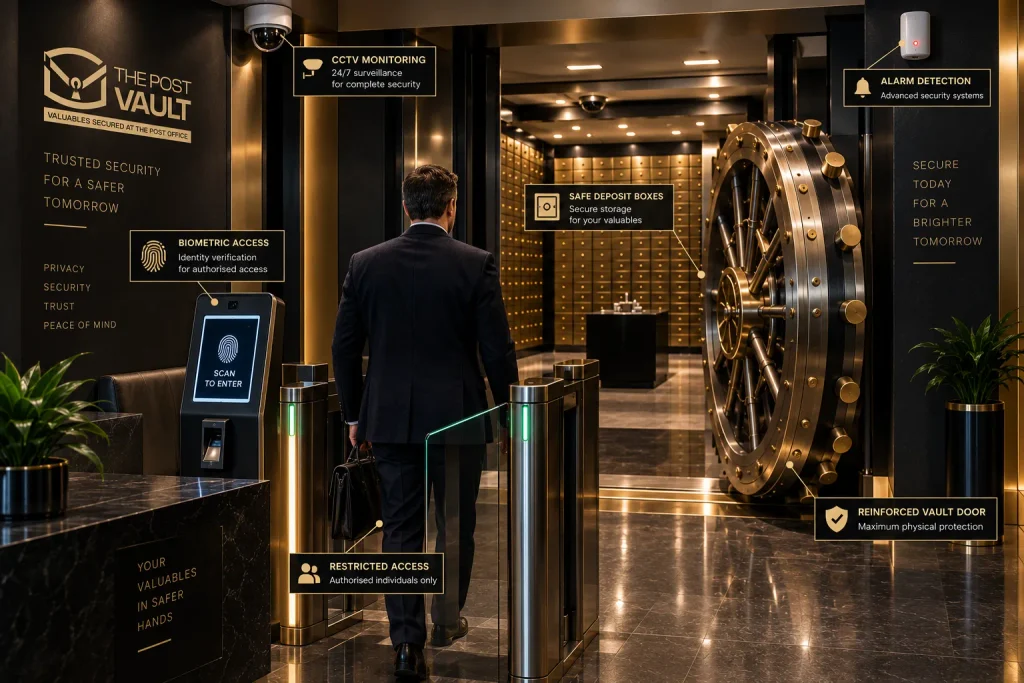
What actually keeps your valuables safe inside a safe deposit box is more than a strong locker and a heavy vault door. The security features a safe deposit box should have are given below
Strong Construction and Reliable Locks
A secure box should be made from durable materials and use a strong locking mechanism. The boxes are typically kept inside protected vaults, making forced entry much more difficult.
Strict Access Controls
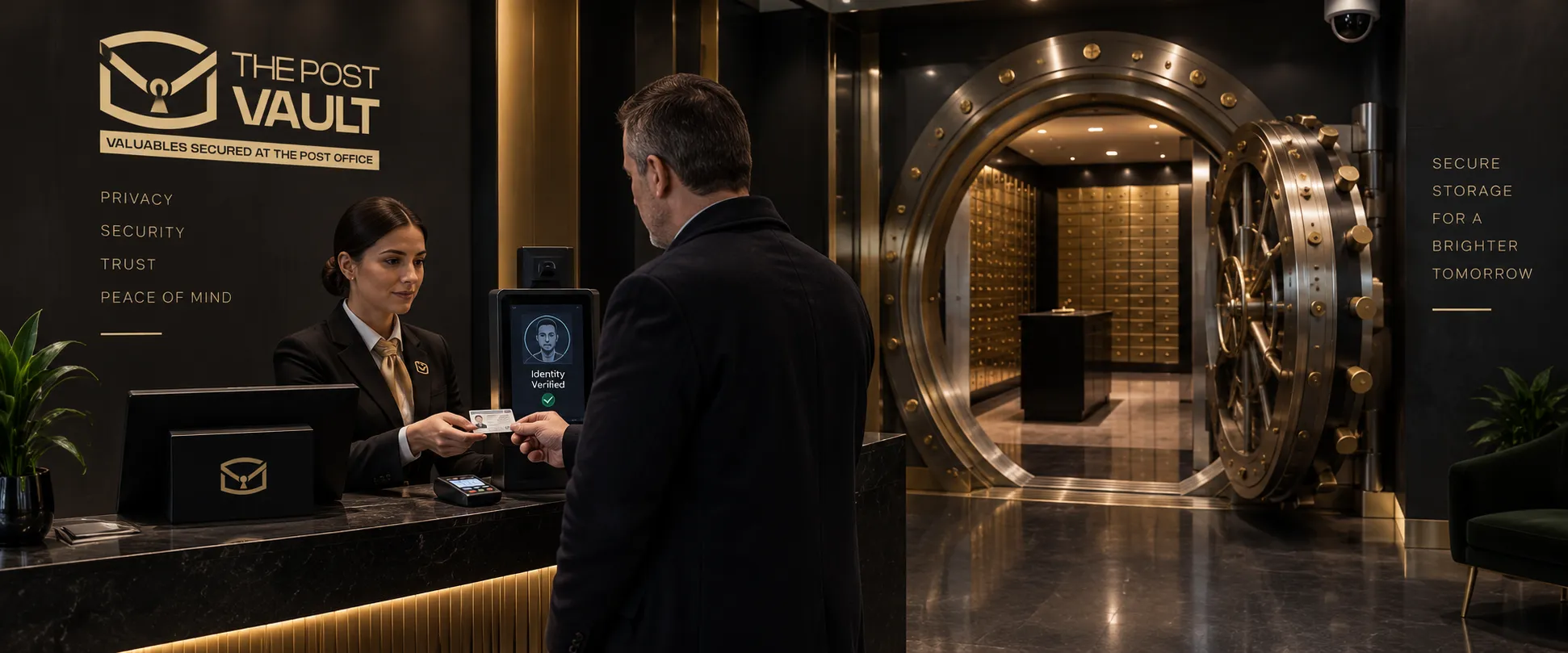
Who can actually enter the vault? That’s where access controls come in. Customers may need to verify their identity, use an access card, use biometric authentication, or follow staff-controlled procedures before reaching their box. The Post Vault offers secure, controlled access procedures designed to help ensure that only permitted customers can reach their safe deposit boxes.
CCTV Monitoring
Security cameras can keep an eye on entrances, corridors, and access areas. Besides discouraging suspicious activity, CCTV can help provide a record if something goes wrong.
Multiple Security Layers
Why rely on one security measure when you can have several? Secure facilities may combine customer verification, restricted areas, staff oversight, and other controls to create multiple barriers against unauthorised access.
Alarms and Detection Systems
What happens if someone tries to force their way in? Alarms, sensors, and intrusion-detection systems can identify unusual activity or tampering and alert security personnel.
Protection from Water and Other Hazards
Security isn’t only about preventing theft. A facility should also consider risks such as water, humidity, and other factors. Depending on the facility, additional measures may help protect stored items from these hazards.
How Do Private Vaults Compare with Bank Safe Deposit Boxes?
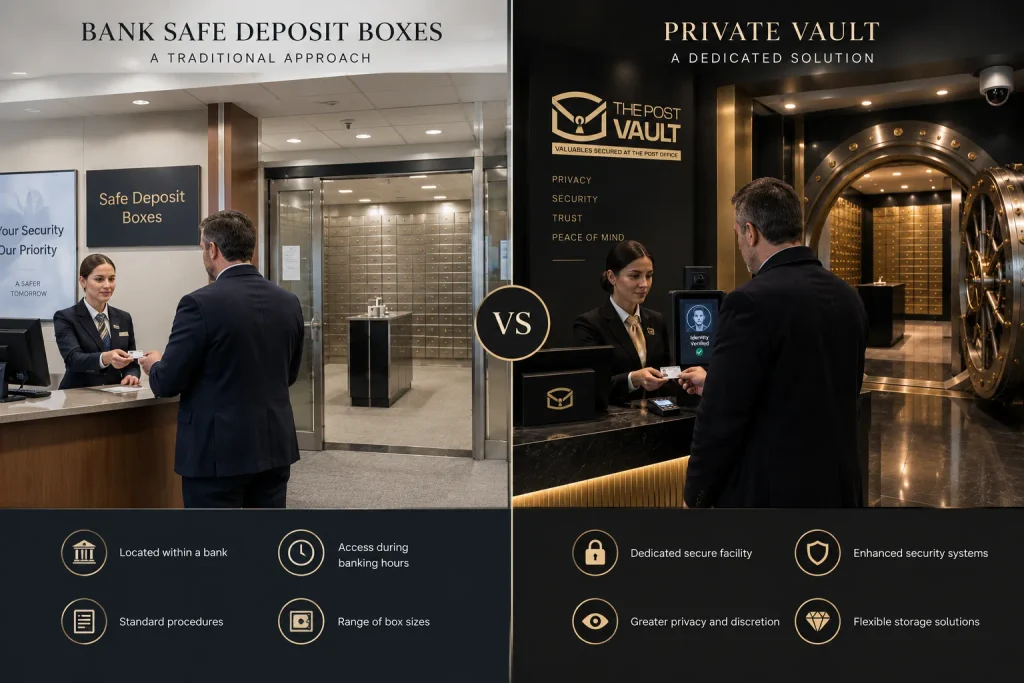
Are private vaults more secure than bank safe deposit boxes? It’s a question worth asking when your valuables deserve more than basic protection. Both options can provide strong security, but private vaults can offer greater privacy, flexible access, dedicated security systems, and more control over how valuables are stored.
Bank safe deposit boxes are secure, but they operate within a traditional banking environment and may come with specific access procedures and limitations. For those who value privacy, convenience, and an additional layer of protection, a private vault can be an attractive alternative to a traditional bank locker. The Post Vault offers secure private vault solutions with controlled, strong security measures and privacy-focused storage, helping you keep your belongings protected.
How can The Post Vault Help You?
When something truly matters to you, why settle for ordinary storage when you can choose protection you can trust? That’s where The Post Vault comes in. Built for those who value security and privacy, we provide secure private vault solutions designed to protect your most important belongings.
Whether you are looking for safe deposit boxes in Bolton, safe deposit boxes in Chorley, or safe deposit boxes in Preston, The Post Vault offers a secure environment supported by multiple layers of protection. Your valuables are kept in a dedicated space where security, privacy, and controlled access remain a priority.
Because protecting what matters shouldn’t be an afterthought. It should be a priority.
Conclusion
So, why do credit checks before opening safe deposit lockers? The answer is not simply about judging a customer’s creditworthiness. Depending on the bank, private vault, and local regulations, financial checks may form part of a wider process designed to verify customers, assess risk, prevent fraud, and meet KYC and AML obligations. From identity verification and customer due diligence to controlled access, surveillance, and strong physical protection, every layer plays a role in keeping valuables and customers secure.
With The Post Vault, customers can choose a private storage environment that is perfect for their belongings. Get in touch today and explore a safer way to protect what matters to you.
Frequently Asked Questions
Why do safe deposit centres ask for ID?
Safe deposit centres ask for ID to confirm that the person accessing a locker is the permitted customer. It helps prevent impersonation, fraud, and unauthorised access.
Is ID verification required to open a safe deposit box?
In many cases, yes. The exact requirements depend on the facility and applicable local regulations, but customers are generally required to provide valid identification before opening or accessing a locker.
Why is customer verification important for safe deposit lockers?
Customer verification helps the facility know who is using its services, manage security risks, and maintain a clear record of authorised access.
Do existing customers need to show ID every time they visit?
Existing customers don’t need to show an ID as they have their own QR code and face recognition.
Why do safe deposit centres need customer information?
Customer information helps facilities establish the customer’s identity, maintain accurate records, and meet applicable security and regulatory requirements.
Is customer verification only about preventing theft?
No. Verification can also help reduce fraud, prevent impersonation, support regulatory compliance, and ensure that only allowed individuals can access a locker.